P-022|当AI进入采购决策:企业需要重新设计什么?|When AI Enters Procurement Decision-Making

当AI进入采购决策:企业需要重新设计什么?
从Gartner Procurement Conference 2026看采购组织设计与判断治理
Gartner在美国圣地亚哥举行Procurement Conference 2026。公开议程将AI应用、采购组织运营模式、人才配置与治理问题带入讨论。其中包括“Empowering Procurement to Lead in the Augmented Era”“Preparing CPOs for AI’s Impact on Procurement Talent”以及“Capability-Driven AI Sourcing: Ensuring Readiness, Governance and Safe Adoption”等议题。
本文依据Gartner公开会议公告与议程展开独立分析,不代表Gartner演讲者的完整观点。
当AI开始参与供应市场研究、报价比较、供应商评估与采购流程,企业面临的变化不只是“能否用AI提高效率”,而是:谁完成工作?谁形成判断?谁有权确认或否决?现有流程与组织治理是否仍然适用?
一、AI改变的不只是工具,而是采购工作的组织条件
第一层变化是任务:资料收集、分析与初步建议可以更快完成。第二层变化是角色:采购人员、品类经理、业务部门、技术团队与AI系统之间的分工可能改变。第三层变化是判断治理:AI提出的建议能否进入决策、何时需要人工确认、出现冲突时由谁负责,取决于组织的权限、流程和控制条件。
这三层不能混为一谈。AI生成更好的建议,并不意味着企业已经建立让这些建议发挥作用的治理机制。
二、一个采购情境:技术能力不等于组织允许
假设AI分析发现,某供应商单价较高,但综合物流、质量与使用成本后,总成本更低。采购人员可能接受这一判断;但如果绩效指标仍只考核采购单价,或审批流程不允许采用综合成本依据,这项判断就可能无法进入正式决策。
AI提供了新的判断输入,不代表组织已经给予它适当的判断权限。 技术部署与治理改变是两项不同的管理工作。
三、独立研究的时间线:不同路径,相近的问题
Alice PLSC Insights关于采购判断与组织治理的研究始于2025年初。我们从长期采购实践出发,逐步形成《采购认知金字塔——采购判断治理模型》,研究采购判断在组织中如何发生,以及权限、流程、组织结构和其他治理条件如何影响判断的形成与实现。
2026年9月的Gartner采购大会公开讨论AI、组织设计、人员配置和治理议题。我们注意到,这些议题与自身研究存在交汇,但研究起点、语言与范围并不完全相同。我们不知道Gartner相关研究始于何时,也不据此主张谁先发现了这些问题。
我们并不是因为大型研究机构开始公开讨论这些问题,才开始思考它们。早在这次大会召开之前,我们已经形成了一套以采购判断为研究对象、解释其在组织中如何发生以及受到何种治理条件影响的独立分析方式。
机构规模并不决定研究问题是否值得提出。更重要的是:分析能否解释现实,方法能否被企业使用,结论能否经受后续实践检验。
四、给企业的一份五步检查路径
AI进入采购后的组织治理检查路径|AI-enabled Procurement Governance Review
怎么用:选择一项已经引入或计划引入AI的采购流程,召集采购负责人、业务代表与相关职能,用五个问题逐项讨论。每一步记录“现状—问题—责任人—下一步行动”,形成一页内部治理检查表。没有部署AI的企业,也可以用相同路径检查现有采购判断机制。
框架状态:基于 Alice PLS Team Insights 采购实践与本次议题形成的实务检查工具(V1.0);并非Gartner框架,也不宣称已完成跨行业实证验证。
五、真正需要重新设计的是什么?
AI可能使采购组织更快获得信息、形成方案和识别风险,但不能自动消除组织中的权限冲突、流程限制与责任空白。企业需要审视的,不仅是采购岗位是否减少或增加,更是判断从产生到被允许、被约束、被采纳和执行的完整过程。
当企业准备引入AI时,是否也准备好重新审视采购判断在组织中如何发生?
Further Exploration|延伸学习

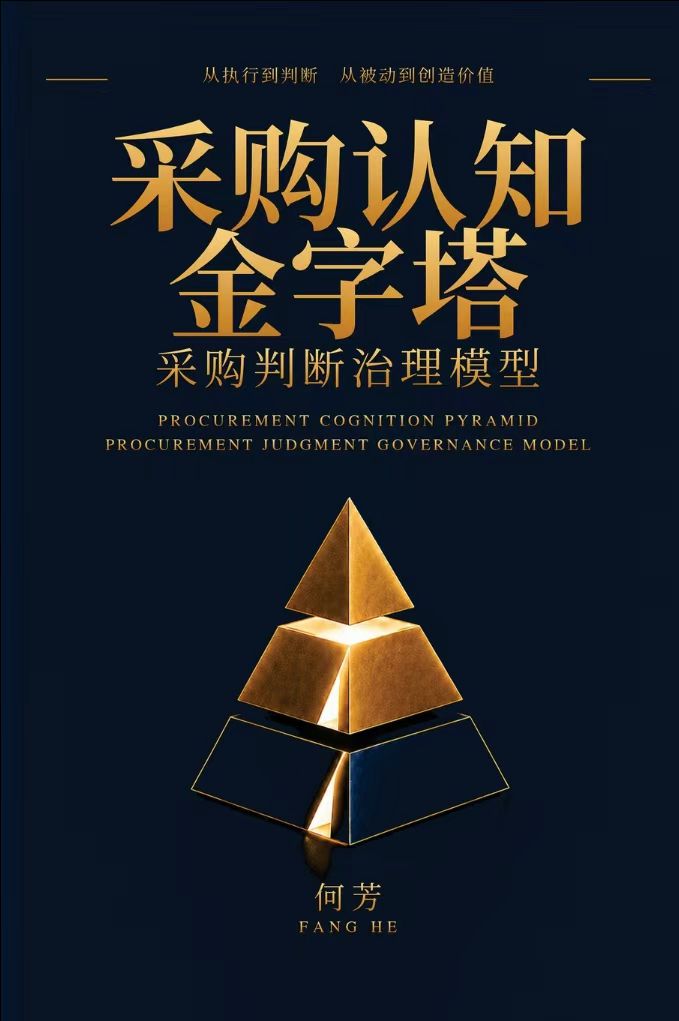
《采购认知金字塔——采购判断治理模型》|何芳(Fang He)著
本书研究采购判断在组织中如何发生,以及权限、流程、结构和治理条件如何影响判断。无论企业是否已经部署AI,都可以借此进一步梳理采购判断与治理机制。
Procurement Judgment Governance Workshop|采购判断治理工作坊
两天核心工作坊;另设一天可选的进阶实践,面向希望进一步开展组织分析与实际应用的参与者。
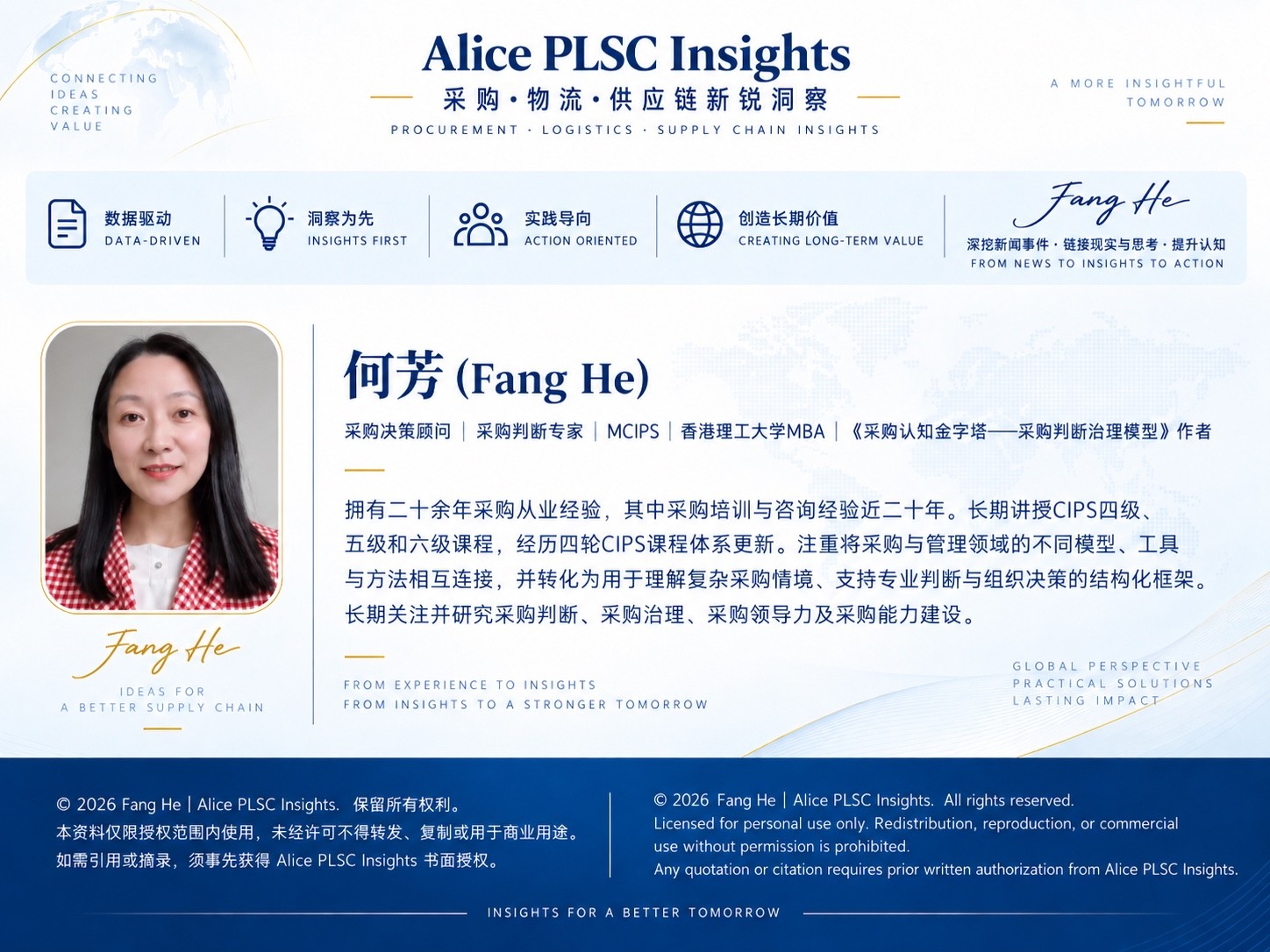
作者:何芳(Fang He)|采购决策顾问 · 采购判断专家
参考来源|Sources
Gartner: Conference announcement, June 3, 2026
Gartner: 2026 conference session archive
Gartner: Capability-Driven AI Sourcing session
Gartner: AI and Procurement Talent session
RESEARCH TAGS|AI Governance · Procurement Judgment · Organization Design · Decision Authority · Procurement Talent · Gartner Procurement Conference 2026
When AI Enters Procurement Decision-Making: What Must Organizations Redesign?
A Perspective on Organizational Design and Judgment Governance Following Gartner Procurement Conference 2026
Gartner held its Procurement Conference 2026 in San Diego, California. Its public agenda addressed AI adoption, procurement operating models, talent and governance. Sessions included “Empowering Procurement to Lead in the Augmented Era,” “Preparing CPOs for AI’s Impact on Procurement Talent,” and “Capability-Driven AI Sourcing: Ensuring Readiness, Governance and Safe Adoption.”
This article draws on Gartner’s public conference announcement and session descriptions. The analysis that follows is independent and should not be attributed to Gartner speakers.
As AI becomes involved in supply-market research, bid comparison, supplier evaluation and procurement workflows, the question is no longer simply whether AI can improve efficiency. It is also: Who performs the work? Who forms a judgment? Who may approve or reject it? Do existing processes and governance arrangements remain fit for purpose?
1. AI Changes More Than Tools: It Changes Organizational Conditions
The first change concerns tasks: information gathering, analysis and preliminary recommendations may become faster. The second concerns roles: the division of work among buyers, category managers, business functions, technical teams and AI systems may shift. The third concerns judgment governance: whether AI-supported recommendations enter a decision, when human validation is required, and who remains accountable depend on organizational authority, processes and controls.
These are distinct changes. Better AI-generated recommendations do not mean that an organization has established the conditions necessary for those recommendations to influence decisions.
2. A Procurement Scenario: Technical Capability Is Not Organizational Permission
Suppose an AI analysis identifies a supplier with a higher unit price but a lower total cost after logistics, quality and usage costs are considered. A procurement professional may accept the analysis. Yet if performance metrics still reward unit-price reductions alone, or approval rules do not accommodate a total-cost rationale, the judgment may never become a formal decision.
AI may provide a new input to judgment without receiving the organizational permission needed for that input to matter. Technology deployment and governance redesign are different management tasks.
3. An Independent Research Timeline: Different Paths, Related Questions
Alice PLSC Insights began researching procurement judgment and organizational governance in early 2025. Drawing on years of procurement practice, this work developed into The Procurement Cognition Pyramid—Procurement Judgment Governance Model, which examines how procurement judgments arise within organizations and how authority, processes, structures and other governance conditions affect their formation and realization.
At its September 2026 conference, Gartner publicly addressed AI, organizational design, talent and governance. We see meaningful intersections with our own research, while recognizing that the starting points, terminology and scope are not identical. We do not know when Gartner began its related research and make no claim to having identified these issues before Gartner.
We did not begin asking these questions because a major research organization started discussing them publicly. Before this conference took place, we had already developed an independent analytical approach centered on procurement judgment: how it arises within organizations and how governance conditions shape what happens to it.
The size of an institution does not determine whether a research question deserves attention. What matters is whether the analysis explains reality, whether organizations can apply the method, and whether its conclusions withstand further examination.
4. A Five-Step Governance Review That Organizations Can Use
AI-enabled Procurement Governance Review
How to apply it: Select one procurement workflow using, or preparing to use, AI. Bring together the procurement owner, business stakeholders and relevant functions. For each step, document the current state, the gap, the accountable owner and the next action on a one-page governance review. Organizations not yet using AI can apply the same questions to existing procurement judgments.
Framework status: Practice-oriented review tool (V1.0), derived from Alice PLS Team Insights procurement practice and the issues examined here. It is not a Gartner framework and has not been presented as a cross-industry empirically validated model.
5. What Really Needs to Be Redesigned?
AI may help procurement organizations obtain information, develop options and identify risks more quickly. It does not automatically remove conflicting authority, procedural constraints or gaps in accountability. The real question is not only whether roles or headcount change, but how a judgment moves from being formed to being permitted, constrained, adopted and implemented.
When an organization prepares to introduce AI, is it also prepared to reconsider how procurement judgment actually happens?
Further Exploration
The Procurement Cognition Pyramid—Procurement Judgment Governance Model | Fang He
This book examines how procurement judgment occurs within organizations and how authority, processes, structures and governance conditions shape it. Its perspective is relevant whether or not an organization has deployed AI.
Procurement Judgment Governance Workshop
A two-day core workshop, with an optional third day for participants who wish to move further into organizational analysis and practical application.
Author: Fang He | Procurement Decision Advisor · Judgment Specialist
Sources
Gartner: Conference announcement, June 3, 2026
Gartner: 2026 conference session archive
Gartner: Capability-Driven AI Sourcing session
Gartner: AI and Procurement Talent session
RESEARCH TAGS|AI Governance · Procurement Judgment · Organization Design · Decision Authority · Procurement Talent · Gartner Procurement Conference 2026