Public Insights|公开洞察

Articles explicitly selected for public reading. Member-only posts are excluded.

Public Insights|公开洞察

C-039|那些说到一半,又咽回去的采购判断|The Procurement Judgments We Leave Unspoken
Alice PLSC Insights

ALICE PLSC INSIGHTS · C-039 · PUBLIC INSIGHTS|公开洞察

让采购工作中零散、交织、说不清的困惑,开始被看见

当“采购能力不足”成为一种熟悉的评价

“采购的能力,还是需要加强。”

“沟通和谈判水平不够。”

“降本力度不够,工作也不够有战略性。”

这些话,你是否听过?可能来自公司的管理层,也可能来自同行谈起自己的工作。朋友抱怨公司的采购做得不够好,采购人员则在另一场交流里,讲起自己那些难以推进的事情。

采购需要持续提升专业能力,这些评价值得认真对待。但如果我们希望理解一件具体的事,还需要往下追问:到底是什么没有做好?当时具备哪些条件,又有哪些条件没有确定?

一句评价,往往装不下一段完整的工作经历。尤其是那些会议已经开过、材料已经补过、相关人员也都沟通过,事情却仍然停在原处的经历。

站在采购自己的位置,有些困难,也许你一直记得,却始终没有找到一种清楚的表达。

会议开起来了,你想说的话却没有说完

你也许熟悉这样的场景。

一项紧急需求已经到了采购这里。你发现,几个关键条件还没有确定,现在就下单,后面可能出现返工、追加费用或者交付风险。于是,你组织了一次会议,希望把事情讨论清楚。

会议确实开起来了。业务说客户已经在催,技术说有些细节还要再确认,项目负责人希望采购先把订单推进。每个人都在回应,也都有自己的紧急任务。

你想继续问:哪些条件可以暂定?后续变化由谁确认?如果现在承诺交期,依据又是什么?

可话还没有说完,讨论已经回到了:“先下单,其他的后面再协调。”

你看了一眼时间,也看见有人开始收拾电脑。还有几个问题到了嘴边,最后只说了一句:“那我再跟供应商沟通一下。”

散会以后,你仍然需要往前推进,也仍然担心那些没有说完的事情。再追问,可能被认为不够灵活;先执行,心里又没有把握。

从会议记录看,这件事已经讨论过了。但你想提出的判断,到底有没有被认真听见,你自己也说不清。

谈判还在继续,能够拿来谈的条件却没有确定

还有一种困惑,可能发生在一次又一次的降本讨论里。

管理层希望采购把价格再降一些。你已经谈过几轮,供应商提出,如果订单数量更稳定,或者付款安排有所调整,价格还有讨论空间。

你把这些条件带回公司。业务暂时无法确认后续需求,财务有现行的付款要求,仓库也有库存压力。每一方都有自己的理由,也都在承担各自的责任。

下一次进度会上,大家问的仍然是:“采购还能再谈下来多少?”

你想解释,价格已经和其他条件连在了一起,单独再压一轮价格,未必能得到想要的结果。

可你又犹豫:继续说,会不会听起来像是在替供应商解释?会不会被认为是在为没有完成降本找理由?

于是,你答应再去谈一轮。

你并不排斥谈判,也愿意继续争取。只是这一次,你不知道自己还可以带着什么条件回到谈判桌,也不知道这部分困难,应该怎样让公司理解。

那些零散的困难,为什么总是说不清

这些场景未必与你的经历完全相同,但其中那种熟悉的感觉,你可能懂得。

你不是没有行动。你准备过材料,组织过会议,也尝试过换一种方式沟通。可有些努力没有留下清楚的结果,有些判断只表达了一半,还有一些,在你真正开口之前就被自己收了回去。

时间久了,这些经历会混在一起,像散落一地的珠子。每一颗你都碰到过,却分不清它们之间有什么联系,又有哪些其实是不同的事情。

你可能会觉得公司不重视采购,也可能开始怀疑自己的水平。你一边想着“也许我还应该再努力一点”,一边又说不清,下一次到底应该把力气用在哪里。

这种不得其解,会让人疲惫。尤其当你在意自己的专业,也希望工作能够做得更好时,最难受的往往是:你知道这里有问题,却无法把它清楚地讲给别人,甚至讲给自己。

这些困惑,值得被认真梳理。我们需要给那些被一句评价带过、被日常忙碌掩盖的经历,留出一点重新理解的空间。

采购判断治理模型:一面帮助你看见的镜子

《采购认知金字塔——采购判断治理模型》,正是从对这些采购处境的持续关注中写成的。

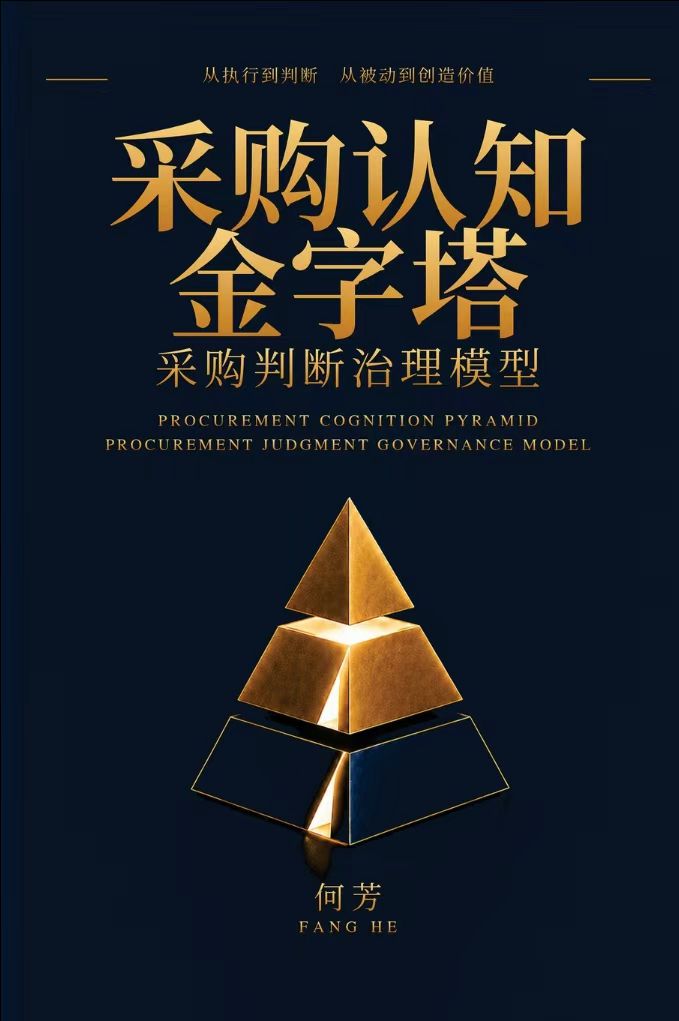
何芳著《采购认知金字塔——采购判断治理模型》正式封面|Procurement Cognition Pyramid — Procurement Judgment Governance Model, by Fang He
何芳 著 · Fang He

采购判断治理模型关注的,是那些已经出现、却难以说清楚的判断与困惑。它像一面结构化的镜子,帮助你把零散、交织的工作感受梳理出来,更清楚地看见它们各自的位置和彼此的关系。

原先笼统的“我就是推进不了”,可以逐渐成为能够描述、能够讨论的问题。原先混在一起的委屈、犹豫和不确定,也有机会被分清、被理解。

你可以因此更清楚地认识自己的处境,也更有依据地向同事、利益相关方或管理层表达:自己困惑的究竟是什么,哪些部分还需要进一步了解。

这面镜子的价值,在于帮助你看见。看见以后,具体需要增长什么能力、调整什么工作方式,或者进一步开展怎样的培训与咨询,需要另作讨论。

模型与工作坊承担的是梳理和理解的工作。后续的能力建设与改进,则可以结合采购认知图谱的培训架构及具体咨询需求继续展开。

带着你的困惑,来参加一场工作坊

围绕采购判断治理模型,我们正在筹备相关工作坊。

你可以带来一段一直放在心里的工作经历:一次没有说完的讨论,一项反复尝试仍难以推进的想法,或者一种始终解释不清的感受。你不需要先把问题整理得很完整;恰恰是那些还没有理清楚的部分,值得在这里获得关注。

工作坊将通过采购判断治理模型,帮助参与者对这些经历和困惑进行梳理与分析,让原先零散的困难更有条理,让一些没有被充分理解的处境有机会被看见。

我们希望你在参与之后,能够更清楚地描述自己的困惑,理解其中不同的问题,并为后续沟通、学习或进一步寻求支持,形成更明确的讨论起点。

如果你是采购管理者,工作坊也提供了一个重新理解团队处境的机会。那些看起来像是不够主动、沟通不畅或者战略性不足的表现,值得结合具体经历认真理解,再讨论需要怎样的支持。

首场工作坊计划于2026年12月至2027年1月期间开展。具体日期、线上或线下形式及参与安排,将在 Alice PLSC Insights 后续公布。

Alice PLSC Insights 会员参加本工作坊可享会员优惠价,具体价格将在报名信息中公布。有意成为会员的读者,欢迎前往 Request Access|申请会员 页面登记意向。

先让那些说不清的事,被认真看见

在采购工作里,我们习惯了赶进度、追结果、回应一个接一个的要求。很多困惑,也就这样被暂时放到一边,直到下一次遇到相似的处境,又重新浮现。

如果你也有这样一件事——努力推进过,反复沟通过,却始终说不清究竟在哪里遇到了困难——欢迎关注我们的工作坊。

让那些曾经说到一半、又咽回去的判断,有机会被重新整理;让那些散落在日常工作里的困惑,开始变得有条理、可理解。

看见,是这本书与这场工作坊希望与你一起完成的事。

The Procurement Judgments We Leave Unspoken

Making sense of the scattered, tangled concerns that are difficult to explain in procurement work

When “procurement lacks capability” becomes a familiar verdict

“Procurement still needs to improve its capabilities.”

“The team needs better communication and negotiation skills.”

“The cost reductions are not enough, and the work is not strategic enough.”

Have you heard comments like these? They may come from senior management or from peers describing their workplaces. A friend complains that their company’s procurement team is not doing enough; elsewhere, a procurement professional describes the things they have struggled to move forward.

Procurement professionals need to keep developing their capabilities, and these comments deserve serious attention. Understanding a particular situation, however, requires further questions: What exactly fell short? Which conditions were in place, and which remained unsettled?

A brief verdict rarely captures a whole working experience—especially one in which meetings have been held, evidence has been supplied and people have been consulted, yet the matter remains unresolved.

From procurement’s position, some difficulties may stay with you for a long time without ever becoming easy to explain.

The meeting takes place, but your point remains unfinished

You may recognize a situation like this.

An urgent requirement reaches procurement. You notice that several important conditions are still unclear. Placing the order now could lead to rework, additional charges or delivery risks. You arrange a meeting to discuss them.

The meeting happens. The business says the customer is pressing for action. The technical team says some details still need confirmation. The project manager wants procurement to move the order forward. Everyone responds, and everyone has urgent priorities of their own.

You want to ask: Which conditions can be provisional? Who will confirm later changes? What supports the delivery commitment we are being asked to make now?

Before you finish, the discussion returns to: “Place the order first. We’ll coordinate the rest later.”

You look at the time and notice someone closing their laptop. There are still questions you want to raise. Instead, you say: “I’ll speak to the supplier again.”

After the meeting, you still need to make progress, and you still worry about the matters left unspoken. Asking again may make you seem inflexible; proceeding leaves you unsure.

The minutes show that the matter was discussed. Whether the judgment you wanted to express was seriously heard is much harder to say.

Negotiations continue, while the terms you can offer remain unsettled

Another kind of uncertainty may arise during repeated cost-reduction discussions.

Management wants a lower price. After several rounds, the supplier says there may be room to negotiate if order volumes become more predictable or payment arrangements change.

You take these conditions back to your company. The business cannot yet confirm future demand. Finance has existing payment requirements. The warehouse faces inventory pressure. Each function has its reasons and responsibilities.

At the next progress meeting, the question is still: “How much more can procurement negotiate off the price?”

You want to explain that price is now tied to other conditions. Another round of price pressure alone may not produce the intended result.

But you hesitate. Will further explanation sound like defending the supplier? Will people hear it as an excuse for missing the savings target?

So you agree to negotiate again.

You are willing to negotiate and keep trying. This time, though, you do not know which terms you can take back to the table, or how to help your company understand this part of the difficulty.

Why these scattered difficulties remain hard to explain

These situations may not match your experience exactly, but the feeling may be familiar.

You have taken action. You have prepared information, organized meetings and tried different ways of communicating. Some efforts have produced no clear response. Some judgments have been expressed only halfway. Others have been held back before you began speaking.

Over time, these experiences become tangled, like beads scattered across a floor. You have encountered every one of them, yet it is difficult to see which are connected and which concern different things.

You may feel that the company does not value procurement. You may also begin to question your own abilities. You tell yourself to try harder, while remaining unsure where to direct your next effort.

That uncertainty is tiring. When you care about your profession and want to do better work, one of the hardest experiences is sensing a problem without being able to explain it clearly to others—or even to yourself.

These concerns deserve careful attention. Experiences passed over in a quick assessment or buried under daily demands need space to be understood.

The Procurement Judgment Governance Model: a mirror that helps you see

Procurement Cognition Pyramid — Procurement Judgment Governance Model grew out of sustained attention to these experiences in procurement.

The model focuses on judgments and concerns that have arisen but remain difficult to articulate. Like a structured mirror, it helps you make sense of scattered and intertwined experiences, seeing their respective places and relationships more clearly.

The broad feeling that “I simply cannot move this forward” can gradually become a concern you can describe and discuss. Frustration, hesitation and uncertainty that once seemed inseparable can become easier to distinguish and understand.

This can help you understand your own situation and explain to colleagues, stakeholders or management what is troubling you and which parts still need to be understood.

The value of this mirror lies in helping you see. What capabilities to develop, working practices to change, or further training and consulting to pursue requires a separate discussion.

The model and the workshop support clarification and understanding. Subsequent capability development and improvement can draw on the Procurement Cognition Atlas training framework and the needs of a particular consulting engagement.

Bring your concerns to a workshop

We are preparing workshops built around the Procurement Judgment Governance Model.

You can bring a working experience that has stayed with you: an unfinished discussion, an idea you have repeatedly struggled to advance, or a feeling you have never fully explained. You do not need to arrive with a neatly defined problem. The parts you have not yet made sense of deserve attention here.

Using the Procurement Judgment Governance Model, the workshop will help participants clarify and analyze these experiences and concerns, bringing greater order to scattered difficulties and making overlooked situations easier to see.

Our aim is to help you leave better able to describe your concerns, distinguish the issues involved and establish a clearer starting point for further communication, learning or support.

For procurement managers, the workshop also offers an opportunity to better understand the situations their teams face. Behavior that appears to lack initiative, effective communication or strategic focus deserves to be understood through specific experiences before deciding what support is needed.

The first workshop is planned for December 2026–January 2027. The date, online or in-person format, and participation details will be announced through Alice PLSC Insights.

Members of Alice PLSC Insights will be eligible for discounted pricing for this workshop. Prices will be announced with the registration details. If you are interested in becoming a member, please register your interest through the Request Access page.

Giving the unspoken room to be seen

In procurement, we are accustomed to chasing progress, delivering results and responding to one request after another. Many concerns are set aside until a similar situation brings them back.

If there is something you have tried to advance and discussed repeatedly, yet still cannot explain where the difficulty lies, we invite you to follow our workshop announcements.

Give those judgments left half-spoken an opportunity to be revisited. Give the concerns scattered throughout daily work a chance to become more coherent and understandable.

Helping you see is what this book and workshop aim to do.

SEARCH TAGS|采购判断 · 采购困惑 · 采购判断治理模型 · 采购工作坊 · 采购认知金字塔

内容说明:文中的工作场景用于呈现采购人员可能遇到的处境,不对应某一家特定企业或单一项目。

Alice PLSC Insights 版权与作者信息

欢迎在文章下方留下不同意见、补充与期待。具有信息价值的评论,经审核后可精选进入 Member Voice。
P / Procurement, Public Insights|公开洞察

P-022|当AI进入采购决策:企业需要重新设计什么?|When AI Enters Procurement Decision-Making

Alice PLSC Insights article header
P-022 | PROCUREMENT & AI GOVERNANCE | OCTOBER 2026

当AI进入采购决策:企业需要重新设计什么?

从Gartner Procurement Conference 2026看采购组织设计与判断治理

新闻观察|2026年9月15—16日
Gartner在美国圣地亚哥举行Procurement Conference 2026。公开议程将AI应用、采购组织运营模式、人才配置与治理问题带入讨论。其中包括“Empowering Procurement to Lead in the Augmented Era”“Preparing CPOs for AI’s Impact on Procurement Talent”以及“Capability-Driven AI Sourcing: Ensuring Readiness, Governance and Safe Adoption”等议题。
本文依据Gartner公开会议公告与议程展开独立分析,不代表Gartner演讲者的完整观点。

当AI开始参与供应市场研究、报价比较、供应商评估与采购流程,企业面临的变化不只是“能否用AI提高效率”,而是:谁完成工作?谁形成判断?谁有权确认或否决?现有流程与组织治理是否仍然适用?

一、AI改变的不只是工具,而是采购工作的组织条件

第一层变化是任务:资料收集、分析与初步建议可以更快完成。第二层变化是角色:采购人员、品类经理、业务部门、技术团队与AI系统之间的分工可能改变。第三层变化是判断治理:AI提出的建议能否进入决策、何时需要人工确认、出现冲突时由谁负责,取决于组织的权限、流程和控制条件。

这三层不能混为一谈。AI生成更好的建议,并不意味着企业已经建立让这些建议发挥作用的治理机制。

二、一个采购情境:技术能力不等于组织允许

假设AI分析发现,某供应商单价较高,但综合物流、质量与使用成本后,总成本更低。采购人员可能接受这一判断;但如果绩效指标仍只考核采购单价,或审批流程不允许采用综合成本依据,这项判断就可能无法进入正式决策。

AI提供了新的判断输入,不代表组织已经给予它适当的判断权限。 技术部署与治理改变是两项不同的管理工作。

三、独立研究的时间线:不同路径,相近的问题

Alice PLSC Insights关于采购判断与组织治理的研究始于2025年初。我们从长期采购实践出发,逐步形成《采购认知金字塔——采购判断治理模型》,研究采购判断在组织中如何发生,以及权限、流程、组织结构和其他治理条件如何影响判断的形成与实现。

2026年9月的Gartner采购大会公开讨论AI、组织设计、人员配置和治理议题。我们注意到,这些议题与自身研究存在交汇,但研究起点、语言与范围并不完全相同。我们不知道Gartner相关研究始于何时,也不据此主张谁先发现了这些问题。

我们并不是因为大型研究机构开始公开讨论这些问题,才开始思考它们。早在这次大会召开之前,我们已经形成了一套以采购判断为研究对象、解释其在组织中如何发生以及受到何种治理条件影响的独立分析方式。

机构规模并不决定研究问题是否值得提出。更重要的是:分析能否解释现实,方法能否被企业使用,结论能否经受后续实践检验。

四、给企业的一份五步检查路径

ALICE PLSC INSIGHTS · PRACTICAL KNOWLEDGE · P-022-A

AI进入采购后的组织治理检查路径|AI-enabled Procurement Governance Review

1. Task|工作任务

列出AI实际参与的采购活动:研究、分析、推荐、执行或监测;区分辅助与自动化。
2. Role|角色分工

明确采购、业务、技术、财务及AI系统分别承担什么工作;识别岗位和能力缺口。
3. Authority|判断权限

标出谁提出建议、谁验证依据、谁批准或否决、何时必须升级处理。
4. Governance|治理条件

检查现有流程、绩效指标、数据规则、控制措施与责任机制是否支持合理判断。
5. Review|持续复核

用真实业务结果检查AI建议的质量、人工干预和组织阻力,并定期调整分工与规则。

怎么用:选择一项已经引入或计划引入AI的采购流程,召集采购负责人、业务代表与相关职能,用五个问题逐项讨论。每一步记录“现状—问题—责任人—下一步行动”,形成一页内部治理检查表。没有部署AI的企业,也可以用相同路径检查现有采购判断机制。

框架状态:基于 Alice PLS Team Insights 采购实践与本次议题形成的实务检查工具(V1.0);并非Gartner框架,也不宣称已完成跨行业实证验证。

五、真正需要重新设计的是什么?

AI可能使采购组织更快获得信息、形成方案和识别风险,但不能自动消除组织中的权限冲突、流程限制与责任空白。企业需要审视的,不仅是采购岗位是否减少或增加,更是判断从产生到被允许、被约束、被采纳和执行的完整过程。

当企业准备引入AI时,是否也准备好重新审视采购判断在组织中如何发生?

Further Exploration|延伸学习

何芳著《采购认知金字塔——采购判断治理模型》正式封面

《采购认知金字塔——采购判断治理模型》|何芳(Fang He)著

本书研究采购判断在组织中如何发生,以及权限、流程、结构和治理条件如何影响判断。无论企业是否已经部署AI,都可以借此进一步梳理采购判断与治理机制。

Procurement Judgment Governance Workshop|采购判断治理工作坊
两天核心工作坊;另设一天可选的进阶实践,面向希望进一步开展组织分析与实际应用的参与者。

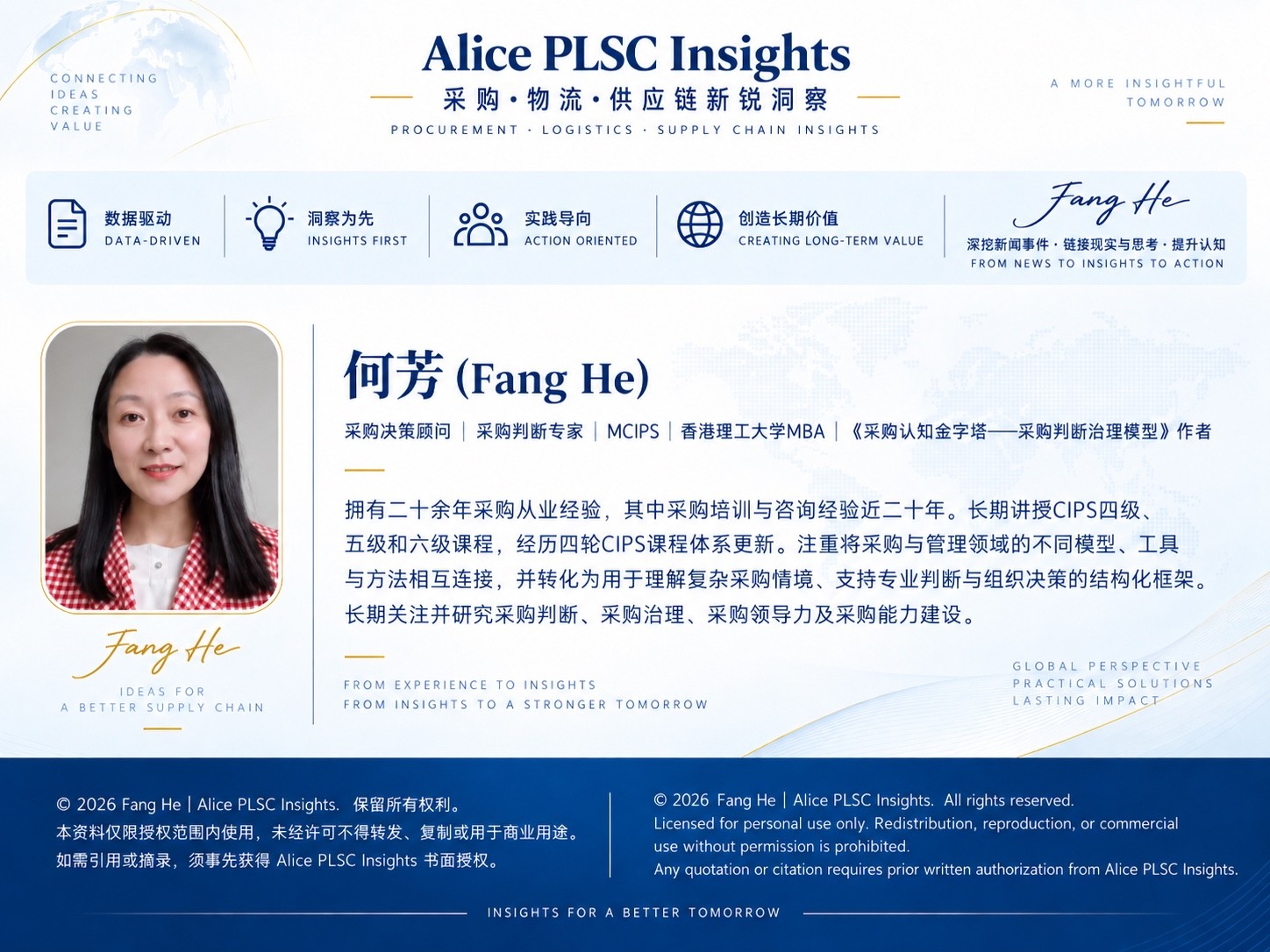
作者:何芳(Fang He)|采购决策顾问 · 采购判断专家

参考来源|Sources

Gartner: Conference announcement, June 3, 2026
Gartner: 2026 conference session archive
Gartner: Capability-Driven AI Sourcing session
Gartner: AI and Procurement Talent session

RESEARCH TAGS|AI Governance · Procurement Judgment · Organization Design · Decision Authority · Procurement Talent · Gartner Procurement Conference 2026


ENGLISH VERSION
P-022 | PROCUREMENT & AI GOVERNANCE | OCTOBER 2026

When AI Enters Procurement Decision-Making: What Must Organizations Redesign?

A Perspective on Organizational Design and Judgment Governance Following Gartner Procurement Conference 2026

Conference context | September 15–16, 2026
Gartner held its Procurement Conference 2026 in San Diego, California. Its public agenda addressed AI adoption, procurement operating models, talent and governance. Sessions included “Empowering Procurement to Lead in the Augmented Era,” “Preparing CPOs for AI’s Impact on Procurement Talent,” and “Capability-Driven AI Sourcing: Ensuring Readiness, Governance and Safe Adoption.”
This article draws on Gartner’s public conference announcement and session descriptions. The analysis that follows is independent and should not be attributed to Gartner speakers.

As AI becomes involved in supply-market research, bid comparison, supplier evaluation and procurement workflows, the question is no longer simply whether AI can improve efficiency. It is also: Who performs the work? Who forms a judgment? Who may approve or reject it? Do existing processes and governance arrangements remain fit for purpose?

1. AI Changes More Than Tools: It Changes Organizational Conditions

The first change concerns tasks: information gathering, analysis and preliminary recommendations may become faster. The second concerns roles: the division of work among buyers, category managers, business functions, technical teams and AI systems may shift. The third concerns judgment governance: whether AI-supported recommendations enter a decision, when human validation is required, and who remains accountable depend on organizational authority, processes and controls.

These are distinct changes. Better AI-generated recommendations do not mean that an organization has established the conditions necessary for those recommendations to influence decisions.

2. A Procurement Scenario: Technical Capability Is Not Organizational Permission

Suppose an AI analysis identifies a supplier with a higher unit price but a lower total cost after logistics, quality and usage costs are considered. A procurement professional may accept the analysis. Yet if performance metrics still reward unit-price reductions alone, or approval rules do not accommodate a total-cost rationale, the judgment may never become a formal decision.

AI may provide a new input to judgment without receiving the organizational permission needed for that input to matter. Technology deployment and governance redesign are different management tasks.

3. An Independent Research Timeline: Different Paths, Related Questions

Alice PLSC Insights began researching procurement judgment and organizational governance in early 2025. Drawing on years of procurement practice, this work developed into The Procurement Cognition Pyramid—Procurement Judgment Governance Model, which examines how procurement judgments arise within organizations and how authority, processes, structures and other governance conditions affect their formation and realization.

At its September 2026 conference, Gartner publicly addressed AI, organizational design, talent and governance. We see meaningful intersections with our own research, while recognizing that the starting points, terminology and scope are not identical. We do not know when Gartner began its related research and make no claim to having identified these issues before Gartner.

We did not begin asking these questions because a major research organization started discussing them publicly. Before this conference took place, we had already developed an independent analytical approach centered on procurement judgment: how it arises within organizations and how governance conditions shape what happens to it.

The size of an institution does not determine whether a research question deserves attention. What matters is whether the analysis explains reality, whether organizations can apply the method, and whether its conclusions withstand further examination.

4. A Five-Step Governance Review That Organizations Can Use

ALICE PLSC INSIGHTS · PRACTICAL KNOWLEDGE · P-022-A

AI-enabled Procurement Governance Review

1. Task

Identify where AI participates in procurement: research, analysis, recommendations, execution or monitoring. Distinguish assistance from automation.
2. Role

Clarify the responsibilities of procurement, business functions, technology, finance and AI systems. Identify capability gaps.
3. Authority

Specify who proposes, validates, approves or rejects a judgment, and when escalation is required.
4. Governance

Test whether workflows, performance measures, data rules, controls and accountability arrangements support sound judgment.
5. Review

Examine actual outcomes, AI recommendation quality, human interventions and organizational friction; revise roles and rules accordingly.

How to apply it: Select one procurement workflow using, or preparing to use, AI. Bring together the procurement owner, business stakeholders and relevant functions. For each step, document the current state, the gap, the accountable owner and the next action on a one-page governance review. Organizations not yet using AI can apply the same questions to existing procurement judgments.

Framework status: Practice-oriented review tool (V1.0), derived from Alice PLS Team Insights procurement practice and the issues examined here. It is not a Gartner framework and has not been presented as a cross-industry empirically validated model.

5. What Really Needs to Be Redesigned?

AI may help procurement organizations obtain information, develop options and identify risks more quickly. It does not automatically remove conflicting authority, procedural constraints or gaps in accountability. The real question is not only whether roles or headcount change, but how a judgment moves from being formed to being permitted, constrained, adopted and implemented.

When an organization prepares to introduce AI, is it also prepared to reconsider how procurement judgment actually happens?

Further Exploration

何芳著《采购认知金字塔——采购判断治理模型》正式封面

The Procurement Cognition Pyramid—Procurement Judgment Governance Model | Fang He

This book examines how procurement judgment occurs within organizations and how authority, processes, structures and governance conditions shape it. Its perspective is relevant whether or not an organization has deployed AI.

Procurement Judgment Governance Workshop
A two-day core workshop, with an optional third day for participants who wish to move further into organizational analysis and practical application.

Author: Fang He | Procurement Decision Advisor · Judgment Specialist

Sources

Gartner: Conference announcement, June 3, 2026
Gartner: 2026 conference session archive
Gartner: Capability-Driven AI Sourcing session
Gartner: AI and Procurement Talent session

RESEARCH TAGS|AI Governance · Procurement Judgment · Organization Design · Decision Authority · Procurement Talent · Gartner Procurement Conference 2026

Alice PLSC Insights footer
P / Procurement, Public Insights|公开洞察

P-016|当 McKinsey 开始谈 Procurement Judgment

Alice PLSC Insights

Public Insight|公开洞察 本篇为 Alice PLSC Insights 公开文章。未经授权请勿全文复制或用于商业用途;引用或摘录请注明来源。

ALICE PLSC INSIGHTS · 2026.10.07 · P / PROCUREMENT

AI进入采购之后,什么才是企业真正应该留下来的能力?

2026年9月23日,McKinsey发表了一篇很值得采购从业者阅读的文章:Rewiring procurement in resources: Making judgment an enduring asset。

真正让我停下来的,不是“AI进入采购”这件事本身,而是标题里的这句话:

01|采购真正稀缺的,可能不是数据

在资源型行业,采购团队经常经历一种 Feast–Famine Cycle:市场上行时迅速扩张,市场下行时人员缩减。

问题是,当有经验的 Category Manager 离开以后,真正消失的往往不只是一个人,而是这个人多年积累下来的供应市场理解、谈判经验、历史决策背景,以及那些很难写进流程文件里的判断。

下一轮周期重新开始,企业又要重新学习。

McKinsey提出的一个重要方向,就是利用AI把这些分散在个人身上的 Category Expertise 更系统地捕捉、组织和复用。

这意味着AI在采购中的价值,可能不仅仅是自动化几个任务。

02|从 Data 到 Intelligence Spine

McKinsey把支撑这些采购工作流的数据与知识基础称为 Intelligence Spine。

它连接的不只是合同和发票,还包括 Vendor Master、Rate Cards、Asset Criticality、Work Orders,以及历史采购策略和专家经验。

这里有一个很值得采购团队注意的变化:

McKinsey给出的一个案例中,一家化工企业把历史采购策略、专家经验和分析能力放进同一个平台,在下一轮招标之前实现了大约 14%的海运费率改善,同时也加快了新 Category Manager 的上手速度。

这已经不只是效率问题。

它开始触及一个更深的问题:

03|但是,知识留下来,不等于判断留下来

这是我读这篇文章时最想继续往前走的一步。

AI可以帮助企业保存历史策略,可以整理合同,可以持续监测市场,可以找到价格变化,也可以根据已有知识提出多个采购方案。

但真正进入决策的时候,采购仍然需要回答:

  • 现在应该重新谈判,还是继续执行合同?
  • 什么时候应该寻找第二个供应商(Second Source)?
  • 价格更低的供应商,是否真的值得切换?
  • 供应连续性和短期成本发生冲突时,应该怎样取舍?
  • AI给出的几个方案都“有道理”时,到底应该选择哪一个?

04|AI越强,采购判断可能反而越重要

过去,采购人员面对的问题常常是信息不够。

未来的问题可能恰恰相反:AI会快速生成更多信息、更多分析、更多选项。

于是采购工作的核心链条可能逐渐变成:

当选择越来越多的时候,真正稀缺的能力不一定是“找到答案”,而是判断:

05|能力之外,还有 Decision Rights

McKinsey在文章里还提出了一个非常重要的设计问题:Decision Rights。

不同采购决策,并不应该给AI相同的权限。

这意味着企业面对的已经不只是一个技术问题:

这两件事情不能混在一起。

06|Workflow is the unit of value

McKinsey还有一句很实用的话:

也就是说,企业不应该因为“要做AI”而做AI,而应该从真正能够创造价值的采购工作流开始。

文章重点讨论了三个方向:Category Management、Continuous Sourcing 和 Leakage Control。

例如在 Leakage Control 中,AI可以把 Contract → PO → Invoice → Actual Delivery 连起来,持续寻找合同执行与实际支出之间的偏差。

McKinsey提到,一家能源企业在超过40亿美元的供应商支出中识别出超过1.2%的支出泄漏机会,潜在年度价值约5500万美元;另一家公用事业企业分析超过100万张发票和600多份合同,准确率超过99%,形成超过1000万美元的年度运行价值。

这也是一个很好的提醒:

07|Making Judgment an Enduring Asset

我很喜欢McKinsey这次使用的这个表达。

因为它把采购能力讨论从“一个采购人员会什么”,往前推了一步:

一个组织究竟能够留下什么?

数据可以留下。

流程可以留下。

合同可以留下。

知识正在越来越容易留下。

下一步真正值得研究的是:

如果可以,那么AI对采购真正深远的影响,也许并不是减少了多少采购人员,而是第一次让企业有机会把原本高度依赖个人的经验与判断,逐渐变成一种可以积累、传递、挑战和持续改善的组织能力。


Further Reading|进一步阅读

《采购认知金字塔——采购判断治理模型》何芳著

《采购认知金字塔——采购判断治理模型》
Procurement Cognition Pyramid — Procurement Judgment Governance Model
何芳 / Fang He

如果McKinsey这篇文章讨论的是如何借助AI保存和放大 Category Expertise,那么《采购认知金字塔——采购判断治理模型》进一步追问的是另一个问题:

  • 采购判断究竟是怎么形成的?
  • 什么因素允许、约束或抑制判断的形成与表达?
  • 个人判断与组织决策之间,究竟是什么关系?

两者并不是同一个研究问题。一个更接近AI时代的采购知识与类别经验如何成为组织资产;另一个关注采购判断本身,以及判断如何在组织中形成、运行和被治理。

SEARCH TAGS|Procurement Judgment · AI in Procurement · Category Management · Decision Rights · Intelligence Spine · Procurement Governance

Sources|资料来源

• McKinsey & Company, Rewiring procurement in resources: Making judgment an enduring asset, September 23, 2026.

说明:文中关于采购判断、AI与采购治理关系的讨论,属于 Alice PLSC Insights 基于公开信息与采购实践提出的分析,不是上述来源的原文结论。

Alice PLSC Insights 版权与作者信息

欢迎在文章下方留下不同意见、补充与期待。具有信息价值的评论,经审核后可精选进入 Member Voice。
滚动至顶部